In the Sep 2020 Burley Line Jason provided some notes describing his efforts of renovating an old baitcaster reel and the full description was added to the gear blog … I thought the article seemed to end abruptly in a cliff-hanger. Little was I to know that a second part was in the mill.
It’s such a common fly now that its easy to take for granted, but the original is quite different from what you might pick up from your local fly shop, and has a history that’s worth understanding.
Frank Sawyer was the inventor of this fly. No flashback, no peacock here, just a simple fly that he used to catch trout for a living on the River Avon the 1920s as a keeper. There are several Avon’s in England, this was the one near Salisbury/Stonehenge. It’s my favourite river name and Avon in proto Celtic means river, so it’s clear what the waterway is!
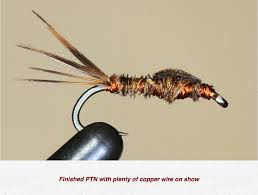
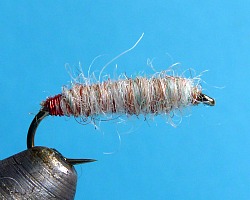
The Sawyer nymph is just small or extra small copper wire (gold, silver and red also work), and several long pheasant tail fibres – not even any thread is required. It’s so simple that I left out the materials list because it looked embarrassingly short! Add a nymph hook of your preference and you are all set.
The tying instructions are also pretty straightforward. Rather than write out a very short list, perhaps it’s best to see Frank himself tie it for us. This is the only footage of him tying recorded:
Out of guilt for the simplicity of the nymph, I’m going to show a second on the night – His Killer Bug. Originally a Grayling fly, but trout don’t seem to be so sophisticated as to care. Again the tying list is three items long, same hook, same wire, and a pinkish, brownish or greenish hank of wool. There’s a whole mythology behind what wool to use, and I have a collection of the ‘right’ ones if anyone wants to drop in and collect a sample, but again, I suspect the trout don’t spend enough time in knitting stores to really care.
NSWCFA have recently amended their webpage to include a link to recent correspondence in and out. Makes for interesting reading to get an idea of what the organisation has been up to.
Oops, Event Calendar should showBrogo, 20-22 Nov. Earlier error now fixed
It has been the Annual General Meeting season – CAA, CFA and MAS (delayed from Feb) – even Queanbeyan Angler’s Club. Notes are here from our AGM including new committee, trophies, Life Membership award and the raffle results plus our outgoing President’s Report on 2019/20 (copied here for those who couldn’t make it to the Zoom meeting). Notes later from CFA and MAS AGMs. QAC was very relaxed so nothing significant to report.
Incoming President, Claude, has penned a message sent out by email to all members. An abstract is included here ‘for posterity’.
Peter and I got up to Jindabyne and the outcome is described here. Where are the other reports on trips folks? I had to convince Jason M to take me out on Lake Ginninderra just today to ensure another fishing report. J Jason has also provided a couple of pieces on gear.
Jaime has sent me a link to remind me of the benefits of fishing as a way to help reduce stress during these COVID times. It would appear that the angling community in the US are commencing a campaign to raise the awareness by the non-angling public of these benefits. Read about it here.
Don’t forget, now that the AGM has passed, membership fees are due. Fees remain at General Membership $40.00, Family Membership $50.00, Concession Membership (age pension or concession card) $15.00 and Junior Membership (U18 years) $15.00. Bank transfer to BSB 032-727, A/C 24-0140 would be preferred. Any contact detail changes can be advised via the webform on our ‘join us’ page.
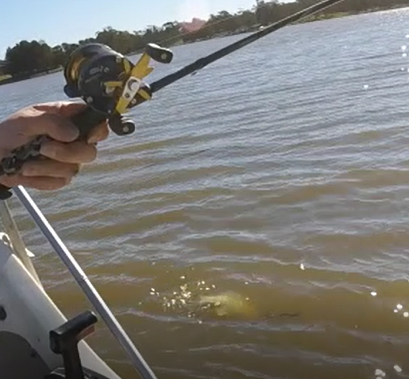
Jason M recently acquired some second hand Abu Garcia level wind baitcaster reels. In Tackling the Trouble he describes some of the maintenance work he did to bring them back to good form. I’ve later discovered this work is actually in two parts. The concluding episode is here.
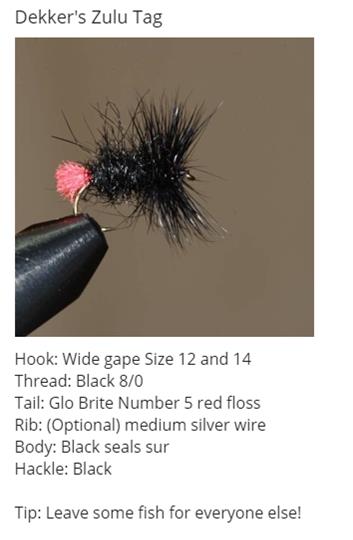
Like the Possum Emerger, it does it all and will catch fish in many circumstances. It’s a great fly to hang a nymph under, such as a 007 for tailing fish and is easy to see in most different types of light.
Don’t be afraid to vary the pattern either, clip the hackle underneath so it sits low, tie it bushy or sparse. Try a hot orange tag or blue wire rib. If you vary it too much you can’t really call it a Zulu anymore but really the basic pattern is all you need.
Attached is a notification about geological investigations at Talbingo Reservoir and continuing work to install the underwater communication cable. The work will involve intermittent disruptions to the boat ramp at Talbingo Reservoir from 1 August to 31 October 2020.
Normally I’d keep this for the next Burley Line (there’s a lot of good stuff here), but there is one item promoting an online session tomorrow 30 Jul.
With contributions from over 100 Indigenous individuals and organisations, these Indigenous-led Guidelines support a step-change in learning, by both Indigenous peoples and their partners, about best practice ways of working with Indigenous knowledge to look after land and sea Country. Supported by NAILSMA and CSIRO, and funded by the Northern Australia Hub of the Australian Government’s National Environmental Science Program (NESP), the Our Knowledge Our Way Guidelines are based on 23 case studies that illustrate the critical principle that Indigenous people must decide what is best practice when working with their knowledge. The launch will be held online between 1-2pm on the 30th July. It features a short film, followed by a Q&A session with indigenous co-authors and partners. Register online here.